Touch typing is an essential skill for working in the IT field or any career where you earn your living at a computer.
In this article, I will tell the story of how I went from typing around 40WPM to 80WPM in two years.
Prerequesites
Where I started from
When I started my upskill journey, I had worked as a professional web developer for about four years. Before I started that job, I did not know how to touch-type, but I had developed my own four-finger technique. I still had to look at the keyboard while typing, but I felt confident in my typing skills. After starting my job, I realized I had to learn touch typing because everyone else in the office typed at what I felt like was blazing speed.
After struggling hard for a couple of months, I got to the point where I could use all my fingers and could type without looking at the keyboard at a pace of around 20-30WPM.
After 4 years of practicing a couple of times a month on keybr.com and typingstudies.com and generally typing a lot on the keyboard, I had naturally reached a speed of 40-50WPM.
I then decided it was time for me to take the leap and reach a speed that would make me feel even more confident behind the keyboard.
High-intensity
Hardcore bonanza
Like most people, when learning a new skill, I was supermotivated and wanted to get as fast on the keyboard in the least amount of time as possible. I dedicated at least one hour each day to nitrotype.com, and my goal was to get all the achievements on the platform. After about two months of practice, my progress stagnated at around 65WPM. Then it went down, and stayed at around 60WPM. Even if it felt like I was typing faster, I was not.
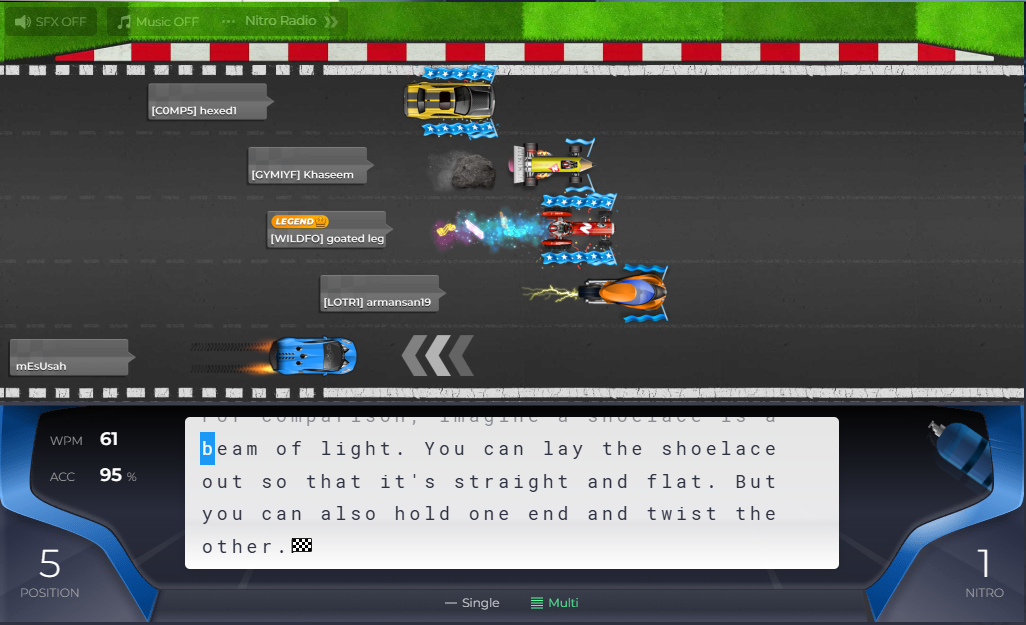
Screenshot from nitrotype.com
Screenshot by Stanley Skarshaug
I then tried to train for longer sessions. Many days for 2 hours, and 3-4 hours on the weekends. Unfortunately, the only thing I gained from this craziness was dry eyes, and sore arms.
Accuracy
Accuracy gives speed
After stagnating at around 60WPM, I realized that my main problem probably was accuracy. I reminded myself that I probably should focus on accuracy before speed. Because of this, I started to exercise touch typing daily for 30 minutes at keybr.com.
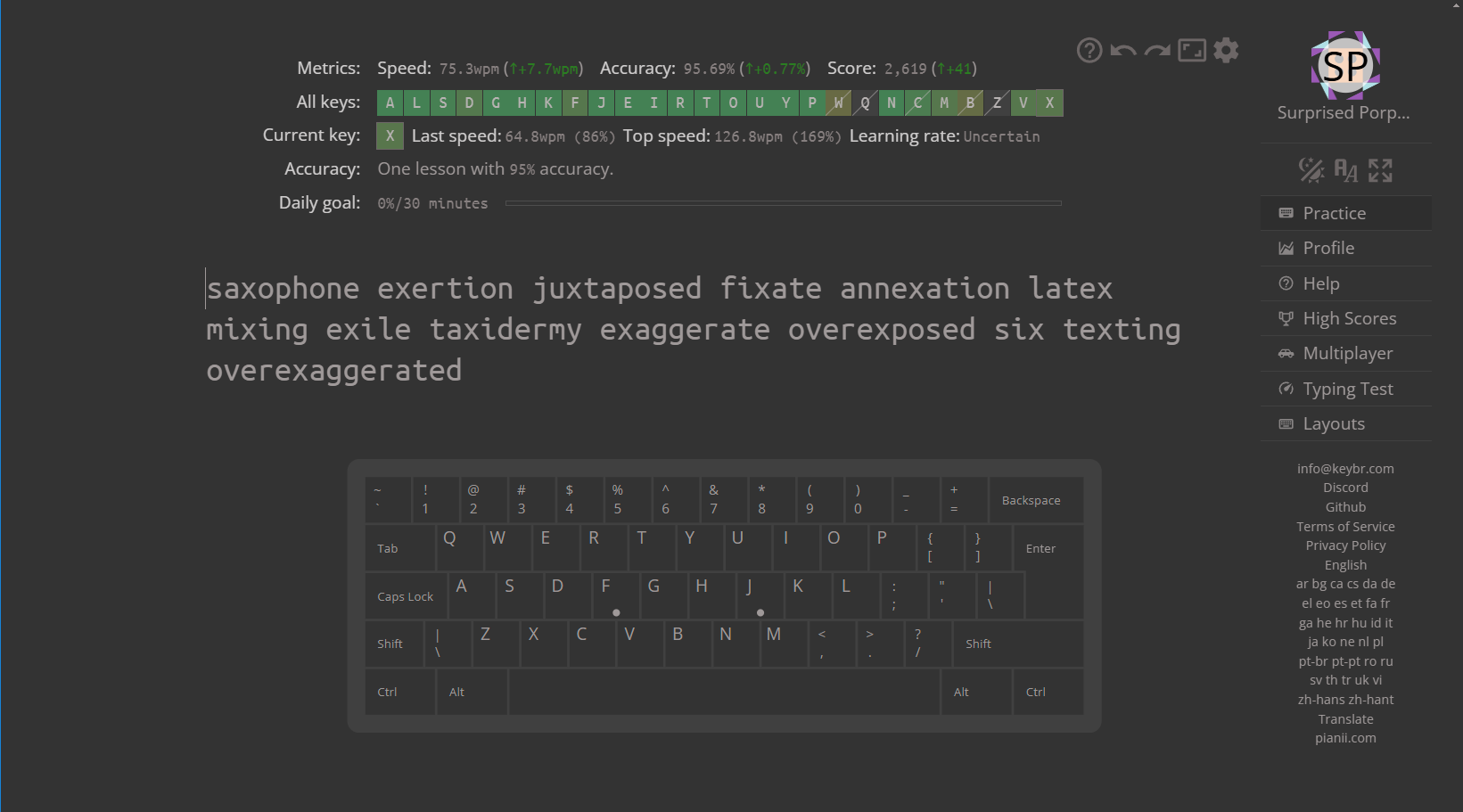
Screenshot from keybr.com
Screenshot by Stanley Skarshaug
I loved how keybr.com generated words using the keys I focused on. This forced me to become better at that specific key.
At first, focusing on accuracy was slow and tedious, but after a couple of months, I noticed a trend of increasing speed proportionally to my accuracy. I saw with my own eyes that with enough accuracy, speed would follow.
At some point during my training, I got stuck on a speed just below 70WPM. It felt like my typing speed increased, but no matter how fast I typed, I never got past an average of 70WPM. After analyzing my progress chart, I noticed that my accuracy was declining over time, despite my typing speed remaining relatively stable. From then on, I refocused on accuracy.
From then on, I focused on typing the rest of the year as accurately as possible.
Posture
Yes, it does matter
Around the half-year mark, I started noticing that when I was typing my fastest and as accurately as possible, I was sitting in the correct position, and my palms stopped resting on the handrest in front of the keyboard. From then on, I started to focus on proper posture when typing my daily exercises. By doing this, I noticed that I began to type slower and less accurately when I got tired from sitting in the proper posture.
Words, not characters
The final stage
When I reached a stable speed of 75 WPM, I realized I needed to focus on words rather than individual characters to make progress. By doing this, I was able to build the muscle memory needed to type words by gesture, rather than focusing on individual characters.
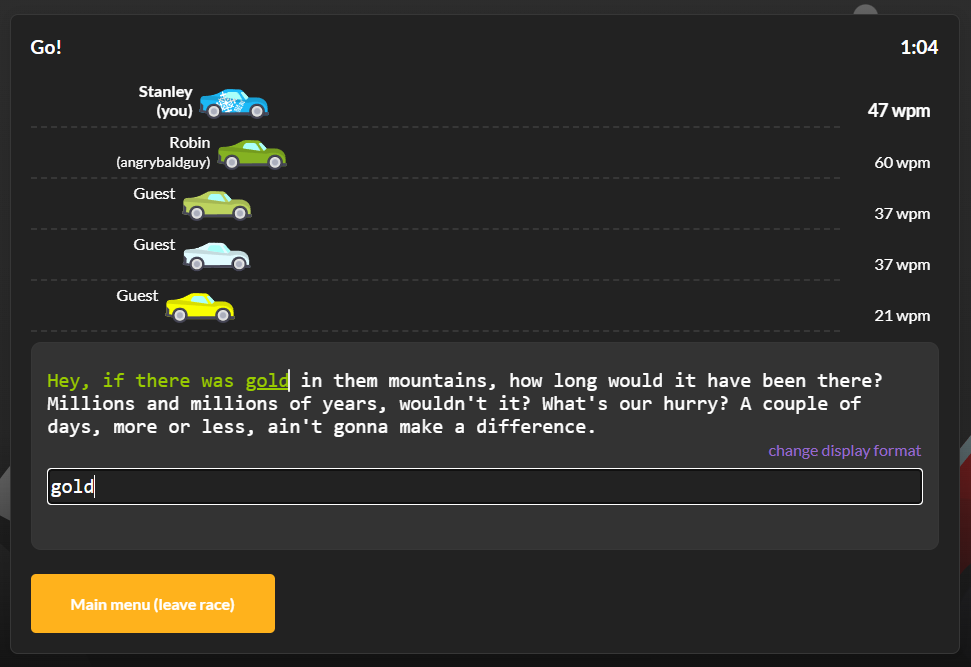
Screenshot from TypeRacer.com
Screenshot by Stanley Skarshaug
I then switch to practicing on typracer.com. Since the platform is much less focused on distractions like the nitro boost to skip difficult words and stickers, and has longer, more varied sentences with an actual message, I was able to focus on more practical, natural sentences.
After only a couple of months of focused practice, I reached an average of 80 WPM. On some runs, I would reach almost 100 WPM, and on others, less than 70 WPM. During those months, I was only practicing 20 races each day. By limiting myself to that amount, I was able to really focus on my accuracy while remaining in a focused state of mind, where I only focused on accuracy.
My advice
What is my key takeaway? What would I change if I was my own coach?
It's hard to say what really worked and what did not work for my progress. But I generally think that practice with intention has much more value than just putting in time practicing.
I also think that any skill you want to master both require practice and rest. When I put in several hours each day, I made less progress than when I limited my practice sessions. I also think that after a period of daily practice, I needed a couple of days, and even weeks, to allow my brain to rewire, and make the muscle memory stick. During those years, I had months when I practiced daily and weeks and even months when I did not.
I still think the hours of brute-force practice had their value, but it just took time for my brain to build the muscle memory required for touch typing.
When watching YouTube videos and reading blog posts about how others learned to type faster, I feel I'm a much slower learner than most who share their journey. I actually think they write those articles and make those videos to rightfully brag. This is why I wrote this article. I don't think it's realistic for most people to type faster than 80 WPM after just a couple of months of practice.
I would like to compare typing to sports. Some people compete at an international level in sports after just a few years of practice, but most spend their entire youth to reach that level. Just like in sports, I think it's unwise to compare yourself and set expectations for your progression to those of people who are gifted. You should rather compare yourself to how you previously performed, and set Specific, Measurable, Achievable, Relevant, and Time-limited (SMART) goals for your typing practice.
I wish I had started to focus on accuracy and proper technique earlier. I think it would have increased my progress.