The Cisco Cybersecurity Associate certification is an associate-level certification, just like the CCNA (Cisco Certified Network Associate). In other words, it is intended as a certification to validate the skills and insights needed to be productive in an entry-level Cyber Security role.
In this article, I will discuss my journey toward certification and recertification, my thoughts on the certification, and recommendations for others considering studying for and taking the certification exam.
When I first wrote this article in 2023, the certification was called Cisco CyberOps Associate, but it was rebranded in 2025 to Cisco Cybersecurity Associate. The differences in the tested curriculum are minimal, but, as with any valuable certification, it was updated to reflect changes in the profession.
When I recertified in late 2025, it included practical, pragmatic approaches to concepts related to the use of LLMs (Large Language Models) and other machine learning tools for security, without any hype.
Why Cybersecurity Associate?
Why I choose to persue the certification
The main reason I chose the Cisco Cybersecurity Associate certification was to verify my basic security knowledge with a certification from a respected vendor. For me, a good grade at school is great, but having a certification is better, even though I think HR, recruiters, and most clients have a better understanding of formal education at colleges and universities.
After reading a lot online, I found that the Cisco Cybersecurity Associate certification covered a similar curriculum to the CompTIA CySA+. Which places it at a higher skill level than the CompTIA Security+ certification. After attempting and failing the CompTIA Linux+ certification, I had issues with the way CompTIA asks its exam questions. In my opinion, CompTIA exams focus on memorizing insignificant details, such as program options/flags, instead of how to do things, and how things function. I wanted to verify my understanding and knowledge, not how hard I worked on memorizing insignificant details before an exam. In real life, you know what you want to do, but you use the man pages or -h/--help option to get a reminder of what options/flags to use. Memorizing program options/flags has little real-world value.
As a bonus, I was able to renew my CCNA certification by passing another associate-level certification from Cisco.
Previous knowledge
What relevant experience I had before studying for cert.
Before starting to study for the Cisco Cybersecurity Associate certification I had passed the CCNA and had been working daily with Linux servers hosting websites and other services. I had also been using Ubuntu Linux as my daily OS, and working as a full-stack web developer for about 3 years. I had also studied for, but not taken the CompTIA Security+ certification. I was also fortunate enough to work in an organization that had security as a focus. So a lot of the things covered by the certification felt relevant for real-world application.
Associate-level
What it means from my point of view
After passing the Cybersecurity Associate certification, I felt in no way, shape, or form ready to work full-time as a security professional. But I did feel that I got a solid foundation for further, and deeper studies, and it felt a lot more advanced than the entry-level CompTIA Security+ certification.
This certification felt solid and covered a significant portion of basic Cyber Security. But, just like the CCNA, it did not verify that I had professional-level knowledge or long experience with the concepts and topics covered by the certification.
Unlike the CCNA, this certification did not focus on the practical configuration of Cisco devices at all. With very few exceptions, it was vendor-neutral. Every topic was theory-based and gave me very few practical, hands-on skills I could apply at work. The practical skills it covered primarily focused on using Wireshark for protocol analysis, nmap for network scanning, and Snort for IDS/IPS rules. I think the certification exam did an excellent job of ensuring that I had a working knowledge of most of the concepts and theories you would expect from an lv.1 SOC analyst or a person with a security focus in an organization.
Timeframe
How long did I study for the certification?
I read one chapter from the official cert guide each week, and I spend a couple of weeks filling my knowledge gaps after reading the book. This made me spend about 18 weeks studying for the Cisco Cybersecurity Associate certification. I could, in theory, have spent much less time, but I fear that would have made it harder for me to retain the knowledge. For me, the certificate was a nice end goal to validate the knowledge I gained, but the knowledge I gained from studying for the certification was what I wanted most.
Videos
Video courses I watched
I watched a lot of videos on LinkedIn Learning, and the entire Cisco CyberOps Associate course by CBT Nuggets during my last exam cram to repeat the information. I think CBT Nuggets provided an excellent review of all the topics covered by the certification. Since I am mainly a software developer, some of the concepts felt a bit boring and hard to learn. So having several people tell about the same concept in different ways, really helped me.
While reviewing the material for my CBROPS-200-201 v1.2 recertification, I really enjoyed an amazing YouTube course by Irene Conrad. This course covers all the exam topics organized by blueprint chapters. This made it really easy for me to look through the blueprint, identify a topic I wanted to review, and find a video by Irene covering it.
Books
Books I read
I read the official cert guide for the Cisco Cybersecurity Associate certification. Just like the CCNA cert guide, this was well-written, easy to understand, and perhaps most importantly: not boring to read. I read it from cover to cover and learned a lot from it. I think this book was an excellent aid in helping me learn the material.
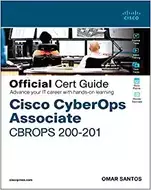
Cisco CyberOps Associate CBROPS 200-201 Official Cert Guide
Omar Santos - 688 sider
The official certification guidebook for the Cisco CyberOps associate certification.
"You could really tell that the author loved to teach, and loved to make the reader understand"
My advice
What i wish i knew before taking the exam
I'm very happy I took the time to study for but did not take the CompTIA Security+ certification before starting to study for the Cisco Cybersecurity Associate certification. The information covered by the Security+ certification was assumed to be prior knowledge throughout most of the material in both the Official cert guide and the video material I watched.
I think a CompTIA Network+ level of networking is required before starting to study for this exam. The study material I watched and read did not spend any time explaining networking. There was some overlap between the security concepts covered in the CCNA and the Cisco Cybersecurity Associate, which really helped me. Especially when it comes to truly understanding what is happening at each layer of the OSI model.
In addition, novice-level experience with Linux is assumed. Without a solid understanding of how Linux distributions operate and function, you will struggle to understand and comprehend many of the concepts covered by this certification. I do think a CompTIA Linux+ level of understanding and experience helps, but, as stated earlier in this article, I do not think the certification exam from CompTIA tested my understanding of Linux.
Having hands-on experience with the material covered by the certification is key, and working with tools such as Snort, NMAP, and Wireshark is essential. Spending some time on all the blue-team-oriented learning paths on TryHackMe helped me connect many of the dots.
Recertification
My thoughts
When I first studied for the certification in 2022/2023, I thought that having a 3-year lifetime of the certification was simply just a way for Cisco to make money by forcing people to recertify.
When I studied to recertify in 2025, I realized why you need to recertify after 3 years. I was surprised at how much I had forgotten in 3 years, and I had to put in more effort than I expected to feel prepared for the exam. Since I had been working as a web developer and rarely had to think about security from a network perspective, it felt great to get a refresher on cybersecurity theory. It was also interesting to learn about the use of ML/AI in cybersecurity.
Summary
Ok, what is the key takeaway?
I studied for this cert while working full-time as a web developer and part-time in the Network and Information Security program at Noroff Vocational College in Norway. The class I was taking at Noroff was equivalent to the old CCNA Security class. This was a big help because there was a huge overlap between that class and this certification.
I think this certification came at the perfect time in my IT journey. Some of the harder-to-understand-before-you-see-it concepts surrounding practical network and system administration and programming were starting to sink in for me. In addition, I had accumulated some experience with situations where we both had, and lacked security solutions, procedures, and tools where I worked. All this made this certification feel relevant and made me appreciate even more the skills needed to work as both a blue teamer and a red teamer.
The exam was hard, but it felt fair. Cisco made me feel like I knew and really understood what I had studied in preparation for the exam. All questions required analysis, and none felt like a test of what I remembered from brute-force exam cramming.
I don't know how recognized the Cisco Cybersecurity Associate certification is in Norway and the rest of the world, but I do know it's not even close to the recognition the CompTIA Security+ or SSCP has. I think it was a great experience and a really big stepping stone in my security journey.
By passing this certification exam and later recertifying, I felt that my knowledge about the basics and general concepts of cybersecurity was validated. This made me confident in the basics, and ready to shift my focus towards more specific parts of cybersecurity.